Gleister’s time machine
The Robot Who Looked Like MeGleister’s time machine is the small device Charlie Gleister invents in Harvest Falls, and the hinge on which the story’s paradoxes turn. It starts as a machine that can flash, make noises, and make its inventor’s skin tingle, but cannot travel through time. Knowledge acquired from the future eventually makes it work in the present. Its operation then helps create the very chain of events from which that knowledge comes: time travel does not merely move Charlie Gleister through history, but makes further Gleisters part of history.
Design and Failed Invention
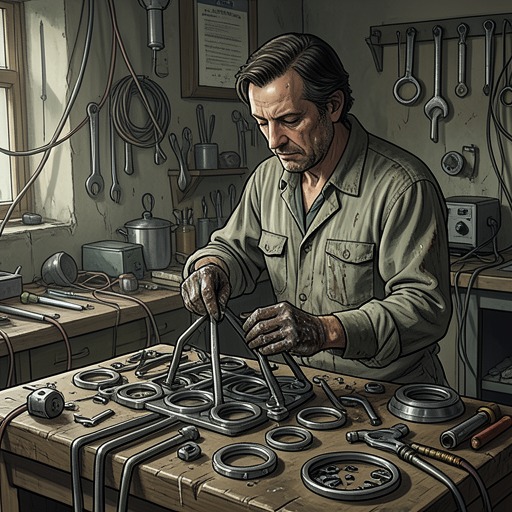
Charlie Gleister’s first machine is about the size of a white plastic shoe box. Dials, switches, levers, and buttons cover its surfaces. When he turns it on, the glow bulbs flash purple and green and the apparatus makes unusual noises. It produces a physical effect on its inventor, but no temporal one: it is, in the narrator’s deliberately comic distinction, an accomplished tingler, flasher, and noisemaker rather than a working time machine.
The contrast between the elaborate controls and the machine’s initial uselessness makes its material presence conspicuous. Charlie Gleister has built an object that looks equipped for action and responds when activated, yet its most evident output is sensation rather than travel. The device is not simply a finished invention awaiting use. Its failure defines the gap between mechanical activity and the capacity it is supposed to provide.
That gap closes only after Charlie Gleister gains enough insight from the future to adjust the machine so it will function in the present. The order is intentionally paradoxical: the device must enable a journey that supplies knowledge needed to make the device work. In this account, invention is not a clean progression from design to successful test. Its completion depends on information arriving from the future it will later allow its inventor to enter.
Activation and the Structure of Time
Once operational, the machine is encased in the same white plastic box, and Charlie Gleister sets its controls to the limit of its forward range. That limit is described across radically different scales: several million years of human time, several hours from a star’s viewpoint, or a googol of chilicosms as seen by a paramecium. He pushes the button and travels forward. The scale-shifting description presents time not as a single human measure but as something that changes with the observer’s frame.
The journey begins with a brief vertigo identified as the Quaestura Effect. Charlie Gleister experiences himself as moving along a line between past and future, with possible branches opening through chance or circumstance. From a larger perspective, however, a time track is a fixed orbit around an incomprehensible center. What seems to the traveler like deviation or novelty can therefore be understood at another scale as a perturbation within a repeating circuit. The machine makes this disagreement between perspectives an experience as well as an idea: travel feels linear to its user, while the story’s wider account stresses recurrence.
The instructions supplied by another Gleister bring that logic to the immediate problem of invention. He tells Charlie Gleister to understand reality as positional and events as things that do not happen for the first time. Charlie Gleister then identifies the loop: he will get the machine working, travel into the future, return, and meet himself just before inventing it. The machine’s functioning and the knowledge that makes it function thus occupy different points in the traveler’s sequence but support one another within the story’s circular time.
The Machine in Emperor Mingus’s Future
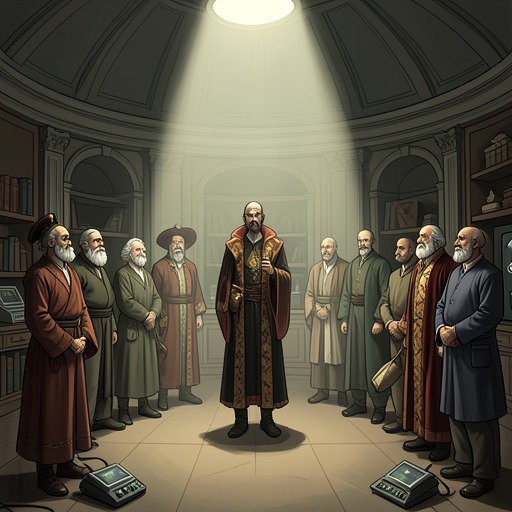
In the future Charlie Gleister reaches, Emperor Mingus possesses a time machine and uses it as an instrument of rule. When something goes wrong, he can travel back and correct it, subject to natural restrictions. The account gives this power a precise political application: rather than searching for an underground opponent after that person has gone into hiding, he can go back to an earlier point in the person’s life, even to childhood, and kill the future resistance leader before the resistance begins.
This use places the machine within a system of pervasive surveillance. Emperor Mingus’s police state relies on cameras, recorders, layers of monitors, and, ultimately, the Emperor as the final observer. Time travel extends that monitoring beyond the present: it allows him to intervene in the past as well as watch the world around him. Yet the power is not unlimited. He must operate the machine personally and cannot entrust it to someone else, because an operator with access to the past could travel back and kill him, taking his position as Emperor.
Even this restriction does not eliminate opposition. Some people cannot be located through time travel, and those who are vulnerable have already been removed. The remaining resistance forces Emperor Mingus’s organization to search for enemies he cannot personally destroy. The machine therefore gives him extraordinary reach without making his rule complete. Its limits shape the political conditions around it, and the existence of those limits leaves space for resistance.
The text establishes that Emperor Mingus possesses a time machine, but does not explain whether it is physically Charlie Gleister’s original device, a later version, or another machine. Its clear connection to Charlie Gleister’s invention lies instead in the shared capacity to alter events through temporal movement. Keeping provenance unresolved preserves a distinction between the known inventor’s small box and the future ruler’s weapon, even as both belong to the same account of time travel.
Displacement and the Gleister Cascade
The account of how Gleisters multiply begins with the first or original Gleister, who builds a time machine and travels into the future. His departure leaves a hole in the space-time fabric: a Gleister is missing from his normal position. Nature fills that absence by supplying an identical or nearly identical Gleister from its reserve of spare parts. The explanation treats the machine’s movement as an event that requires a corresponding presence to restore what has been displaced.
The process repeats with each use. Every time a Gleister travels, another hole appears, and Nature produces another Gleister to fill it. The result is not one inventor following a single path, but numerous versions pursuing different missions. One sequence becomes Emperor Mingus; another organizes against him; other sequences also arise. Each newly produced Gleister can in turn travel and help produce still more versions, turning the machine’s use into a self-propagating cycle.
The machine’s decisive significance is therefore larger than its ability to transport one person through time. It connects Charlie Gleister’s incomplete invention to future knowledge, and individual journeys to a multiplying population of Gleisters whose divergent sequences shape political history. The paradox is not an incidental defect that the machine must overcome. It is part of the system in which the machine works: each apparent absence is filled, each journey can generate another traveler, and the route from invention to consequence loops back on itself.